|
Now linked to (Oct. 11, 1997):
American Literature on the Web
Top
Chronology 1
Chronology 2
End
 Portrait
Life
Art
Critics
Barrel Portrait
Life
Art
Critics
Barrel

You are visitor number
 since
March 1, 2000.
since
March 1, 2000.
Portrait Gallery
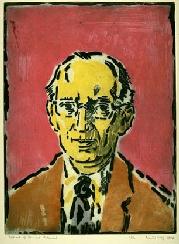
Self-Portrait of the Artist (1984)
A Portrait of the Artist by Philip Roth
 If you prefer the frame, click on The "Framed" UBMHP. If you prefer the frame, click on The "Framed" UBMHP.
|
Well, we were here, first-generation Americans, our language was
English and a language is a spiritual mansion from which no one can
evict us. Malamud in his novels and stories discovered a sort of
communicative genius in the impoverished, harsh jargon of immigrant New
York. He was a myth maker, a fabulist, a writer of exquisite parables.
The English novelist Anthony Burgess said of him that he "never forgets
that he is an American Jew, and he is at his best when posing the
situation of a Jew in urban American society." "A remarkably consistent
writer," he goes on, "who has never produced a mediocre novel .... He
is devoid of either conventional piety or sentimentality ... always
profoundly convincing." Let me add on my own behalf that the accent of
hard-won and individual emotional truth is always heard in Malamud's
words. He is a rich original of the first rank.
(Saul Bellow's eulogy, wrote for a memorial tribute to Malamud, 1986)
|
Top
Chronology 1
Chronology 2
End
Chronology of Bernard Malamud
- 1914
Bernard Malamud is born in Brooklyn, New York, to Bertha and Max Malamud.
- 1928-32
Attends Erasmus Hall High School.
- 1932-36
Attends City College of New York; receives bachelor's degree in 1936.
- 1937-38
Attends Columbia University.
- 1940-48
Works as clerk in Bureau of Census, Washington, D.C.
- 1940-48
Teaches evening classes at Erasmus Hall High School.
- 1941
Begins writing short stories.
- 1942
Receives Master's degree from Columbia University.
- 1943
Publishes first stories: "Benefit Performance" in Threshold and "The Place Is Different Now" in American Preface.
- 1945
Marries Ann de Chiara; lives in Greenwich Village.
- 1947
A son, Paul, is born.
- 1948-49
Teaches evening classes at Harlem Evening High School.
- 1949-61
Teaches at Oregon State College, Corvallis, Oregon.
- 1950
Stories appear in Harper's Bazaar, Partisan Review, Commentary.
- 1952
The Natural is published. A daughter, Janna, is born.
- 1956-57
Malamud receives a Partisan Review fellowship in fiction; lives in Rome and travels in Europe.
- 1957
The Assistant is published.
- 1958
The Magic Barrel is published. Malamud receives the Rosenthal Foundation Award of the National Institute of Arts and Letters for The Assistant.
- 1959
Receives the National Book Award for The Magic Barrel. Receives a Ford Foundation Fellowship in humanities and the arts.
Top Chronology 1 Chronology 2 End
- 1961
A New Life is published. Joins the faculty of Bennington College, Bennington, Vermont.
- 1963
Idiots First is published. Travels in England and Italy.
- 1964
Becomes a member of the National Institute of Arts and Letters.
- 1965
Travels in the Soviet Union, France, and Spain.
- 1966-68
The Fixer is published. Becomes visiting lecturer at Harvard University.
- 1967
Wins the National Book Award and the Pulitzer Prize for The Fixer. Becomes a member of the American Academy of Arts and Sciences.
- 1968
Visits Israel in March.
- 1969
Pictures of Fidelman: An Exhibition is published.
- 1971
The Tenants is published.
- 1973
Rembrandt's Hat is published.
- 1979
Dubin's Lives is published.
- 1982
God's Grace is published.
- 1983
The Stories of Bernard Malamud is published.
- 1986
Malamud dies of heart attack.
- 1989
The People and Uncollected Stories is published.
- 1997
The Complete Stories is published.
- 2006
My Father Is a Book, a memoir by his daughter Janna Malamud Smith, is published.
Top
Chronology 1
Chronology 2
End
|
 This
site is still under construction, please come back to try
again later.
This
site is still under construction, please come back to try
again later.